


Game on: Cross-campus collaboration brings art, technology and play to young neurology patients
LEXINGTON, Ky. (Sept. 30, 2026) — For children participating in a six-minute walk test at the University of Kentucky, a trip down the clinic hallway can now become something more: a game.
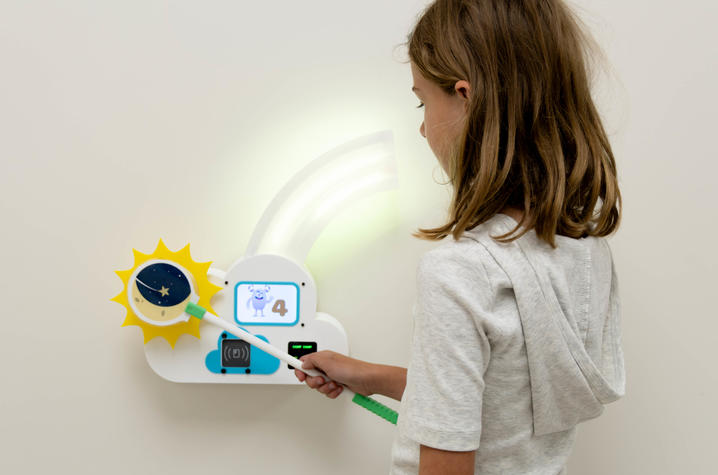
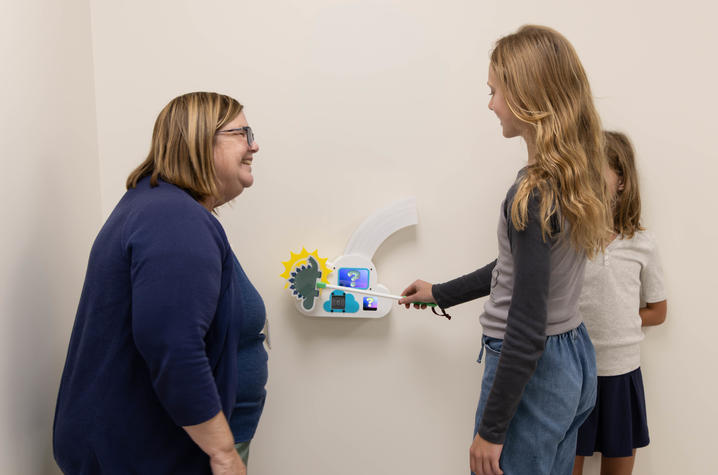
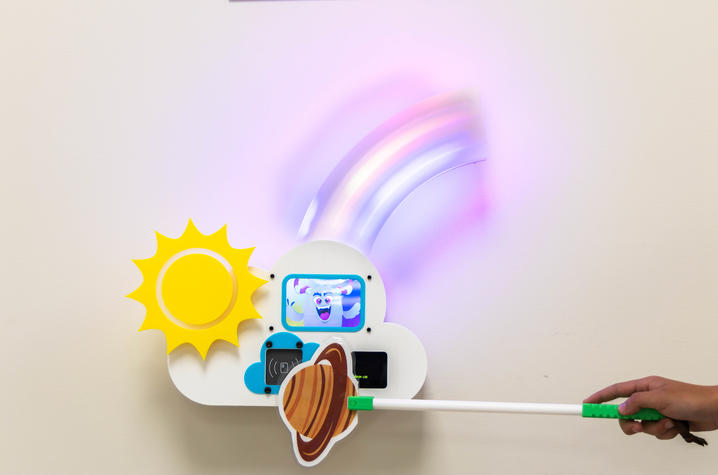
Armed with a wand of their choosing, young patients move through a course with interactive stations positioned along the route. At each completed lap, they scan the wand to earn a point and level up an avatar displayed on a screen.
Behind the playful experience is a serious research question: Can turning a standard clinical assessment into a game help children with neuromuscular disorders remain engaged and give their best effort?
A new UK clinical trial is evaluating whether the gamified experience affects children’s performance, motivation and enjoyment during the six-minute walk test. The project brings together clinical providers with faculty in the UK College of Fine Arts, demonstrating how collaboration among medicine, art, design and technology can produce creative approaches to patient care.
The connection was facilitated through the University of Kentucky Arts & Health Alliance, an interdisciplinary network that brings together faculty, staff and students to integrate creative practice with health research and clinical care. The team is working within Creative Link for Advancing Digital Health, an initiative funded by UK’s Office of the Vice President for Research through the Research Leadership Academy. Creative Link brings together people from different disciplines to explore how the arts and creative practices can contribute to digital health research and innovation.
“This test gives us valuable information about a child’s functional abilities, but six minutes is a long time to ask a child to walk back and forth down a hallway,” said David Neil Toupin, M.D., the study’s principal investigator and director of UK’s Neurology Evaluation and Management Optimization (NEMO) Clinic. “By introducing an interactive goal, we hope to make the experience more engaging and better understand how motivation influences children’s performance.”
Making a clinical test more engaging
The six-minute walk test is commonly used to assess endurance and functional walking ability. During the test, a patient is asked to walk as far as possible in six minutes while clinicians record the total distance traveled.
For pediatric patients, however, the repetitive nature of the assessment can make maintaining interest and motivation difficult. If a child slows down or does not complete the test, clinicians may not know whether the result reflects the child’s physical capacity, fatigue, boredom or a lack of motivation.
That uncertainty inspired the UK team to explore a more engaging approach.
In the gamified version, the child carries a radio-frequency identification tag incorporated into a plastic toy wand. After completing a lap of the 90-foot course, the child taps the wand against a reader to earn a point and advance an on-screen character.
The system does not change the fundamental physical task. Children still walk the same hallway course for six minutes. Instead, it adds visual feedback, a sense of progress and a goal beyond simply reaching the end of the test.
“We want the result to reflect what a child is physically able to do as accurately as possible,” Toupin said. “If the game helps a child stay interested and continue walking, it may give us a clearer picture of their endurance while also creating a more positive clinical experience.”
The pilot study plans to enroll up to 20 children ages 6 to 12 who have been diagnosed with, or are being evaluated for, a neuromuscular disorder and are able to attempt the walking test. Researchers are comparing the gamified experience with the standard version of the test, which uses consistent verbal encouragement at one-minute intervals.
The study’s primary outcome is the distance participants walk. Researchers will also examine children’s perceived exertion and enjoyment, along with recruitment and test-completion rates.
Connecting design with patient care
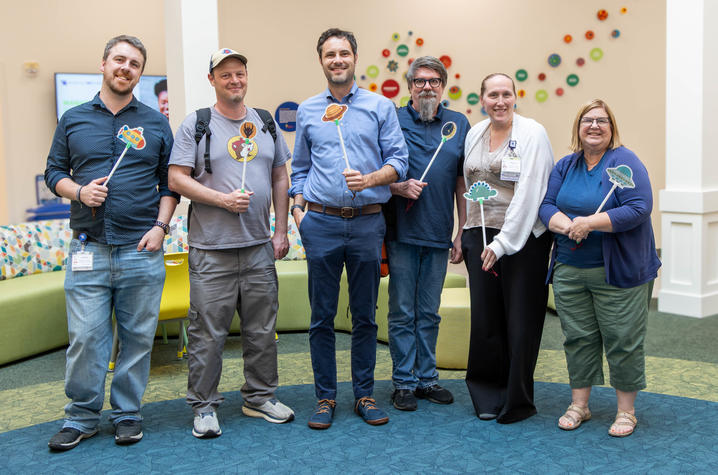
The prototype was developed through a collaboration involving Dmitry “Dima” Strakovsky and Chad Eby in the UK College of Fine Arts and clinicians in the NEMO Clinic. Strakovsky, an associate professor, is part of the Arts & Health Alliance’s leadership team.
Strakovsky said the project represents an opportunity to move conversations about gamification beyond theory and apply design directly to a need identified by clinicians and patients.
“There has been a great deal of discussion about gamification and the ways it might improve people’s experiences, but examples of it being implemented in an actual clinical environment are still relatively rare,” Strakovsky said. “This project allowed us to connect creative ideas with real patients and a real clinical need. That connection is where design can have a meaningful impact.”
Developing the system required the collaborators to consider both the child’s experience and the realities of administering a standardized clinical assessment. The technology needed to be fun and intuitive without distracting from the test, interfering with patient safety or changing the underlying activity researchers want to measure.
Strakovsky credits Toupin and the NEMO Clinic team with helping bridge the distance that can sometimes exist between design concepts and their practical use.
“Designers can imagine many possibilities, but those ideas become powerful when we work alongside people who understand the patients, the clinical setting and the problem that needs to be solved,” Strakovsky said. “This is a strong example of what can happen when people from disciplines that do not typically work together are given a framework to connect, experiment and believe in an idea.”
The project also demonstrates how university initiatives and internal research support can help faculty establish unconventional partnerships, build prototypes and test early concepts.
“The Arts & Health Alliance and Creative Link helped create the conditions for this collaboration to happen,” Strakovsky said. “This project shows what UK can accomplish when people across the university align their expertise around a shared goal — and, ultimately, what those connections can do for patients and families across the Commonwealth.”
Research embedded in multidisciplinary care
The study is being conducted within UK’s NEMO Clinic, where children with neuromuscular conditions receive coordinated care from a multidisciplinary team.
The clinic brings together specialists from child neurology, physical therapy, occupational therapy, speech-language pathology, physical medicine and rehabilitation, and other areas. Integrating the research into a multidisciplinary clinic visit allows the team to evaluate the new approach in the same environment where functional testing and care take place.
As a physical therapist in the NEMO Clinic, Catherine Gohrband sees firsthand how a child’s interest and motivation can affect functional assessments such as the six-minute walk test.
“Physical therapists use the six-minute walk test to better understand a child’s endurance and functional mobility, but the results can be influenced by how engaged that child is in the activity,” Gohrband said. “Adding an element of play gives children something meaningful to work toward. We hope that makes the test more enjoyable for them while helping us capture a more accurate picture of what they are physically capable of doing.”
Gohrband said the project also reflects the value of having multiple disciplines working together to identify challenges and develop solutions centered on each child.
“One of the strengths of the NEMO Clinic is that we are able to look at a child’s needs from several different perspectives,” Gohrband said. “This project grew from a challenge we were seeing during patient care and brought together clinical expertise, technology and creative design to explore a new way of addressing it.”
“The NEMO Clinic is built around collaboration,” Toupin said. “Families can see multiple specialists who communicate with one another and consider the whole child. Incorporating this research into that setting is a natural extension of our goal to make care more coordinated, informative and responsive to children’s needs.”
The UK study is expected to continue through June 2027. Although the initial trial is small, the researchers hope it will provide useful information about the feasibility of the system and whether gamification could improve children’s engagement with clinical testing.
For the children participating, the experience may be as simple as choosing a favorite wand, completing another lap and watching an avatar reach the next level. For the researchers, each scan offers data that could help them understand how creativity and play might make clinical measurement — and the experience of receiving care — better.
UK HealthCare is the hospitals and clinics of the University of Kentucky. But it is so much more. It is more than 10,000 dedicated healthcare professionals committed to providing advanced subspecialty care for the most critically injured and ill patients from the Commonwealth and beyond. It also is the home of the state’s only National Cancer Institute (NCI)-designated Comprehensive Cancer Center, a Level IV Neonatal Intensive Care Unit that cares for the tiniest and sickest newborns and the region’s only Level 1 trauma center.
As an academic research institution, we are continuously pursuing the next generation of cures, treatments, protocols and policies. Our discoveries have the potential to change what’s medically possible within our lifetimes. Our educators and thought leaders are transforming the healthcare landscape as our six health professions colleges teach the next generation of doctors, nurses, pharmacists and other healthcare professionals, spreading the highest standards of care. UK HealthCare is the power of advanced medicine committed to creating a healthier Kentucky, now and for generations to come.