


New Sanders-Brown program helps recent graduates explore careers in Alzheimer’s research
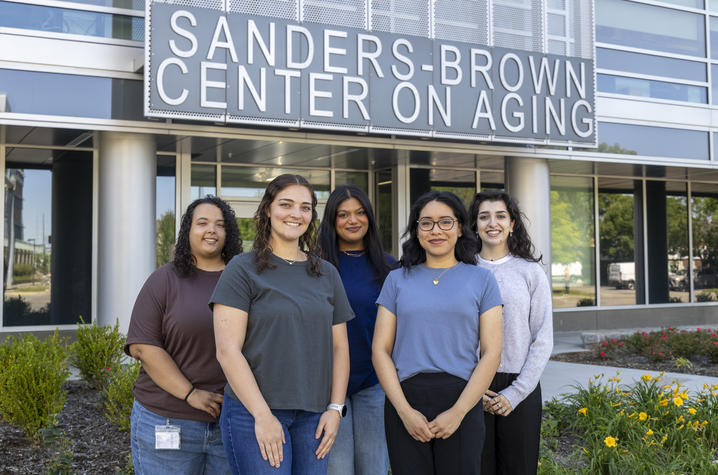
LEXINGTON, Ky. (Sept. 23, 2026) — When Lauren Poe graduated from Centre College in 2025, she knew she was interested in medicine. She had not yet imagined research as part of her career.
The Prestonsburg, Kentucky, native had little research experience beyond the laboratory work required for her biology degree. An online search led her to a post-baccalaureate program at the University of Kentucky’s Sanders-Brown Center on Aging — and an opportunity to discover a side of science she had not previously been able to explore.
“I don’t think I would have known that I enjoy research without this opportunity,” Poe said. “Being able to learn about research and gain experience firsthand has helped me make more informed decisions about my future career.”
Poe is one of six recent graduates participating in the Kentucky Alzheimer’s Disease Research Training and Education Program, or KYAD-PREP. Supported by a five-year, $2.1 million grant from the National Institutes of Health, the program provides paid, full-time research positions, mentorship, coursework and professional development for recent college graduates interested in aging and Alzheimer’s disease research.
The program is designed to address an important gap between completing an undergraduate degree and choosing a long-term career path, said M. Paul Murphy, Ph.D., a professor in the Department of Molecular and Cellular Biochemistry in the UK College of Medicine. Murphy serves as the associate director for education at Sanders-Brown.
“Students may finish college with strong science backgrounds but still be asking, ‘What do I do now?’” Murphy said. “They may be considering medical school, graduate school or another career but have never had the chance to see what research actually looks like. We want to give promising students that opportunity and help them consider a career in aging and Alzheimer’s disease research.”
The program places particular emphasis on reaching graduates of smaller colleges and universities in Kentucky and the Appalachian region, where students may have limited access to biomedical research.
“There are talented students who do very well in their science courses but attend schools where there may be only a handful of research opportunities — and perhaps none related to neurodegenerative disease,” Murphy said. “We are well positioned geographically to introduce those students to the many different careers that exist in aging and Alzheimer’s research.”
Poe’s experience reflects that mission. At Sanders-Brown, she works with Greg Jicha, M.D., Ph.D., and his team at UK’s Alzheimer’s Disease Research Center. Her primary project focuses on developing a brief cognitive test that could be practical for use in primary care.
She has also worked directly with research participants, conducted cognitive testing, learned to administer different cognitive assessments, and gained experience writing a scientific manuscript.
“One of my favorite parts has been getting to meet and work one-on-one with the participants,” Poe said. “I’ve learned how to communicate with someone with Alzheimer’s disease in a way that helps them feel comfortable and calm. I’ve also been able to see firsthand how closely research and patient care are connected.”
The experience has helped Poe realize that she may not have to choose between medicine and research. She can envision becoming a physician while remaining involved in research related to aging and Alzheimer’s disease.
For Andrea Hernandez Gonzalez, the program offered a path back to science after time away from school.
Hernandez Gonzalez grew up in Cynthiana, Kentucky, and began her college education at Bluegrass Community and Technical College before transferring to UK in 2020. A first-generation college student, she navigated the transition to a university during the COVID-19 pandemic and graduated in 2024 with bachelor’s degrees in biology and neuroscience.
After graduation, she worked full time as a hospital receptionist while paying down student debt. She knew she wanted a career in science but was unsure how to take the next step.
While searching online, Hernandez Gonzalez bookmarked a laboratory technician position that caught her attention. Soon afterward, one of her former research mentors, Luke Bradley, Ph.D., co-director of the KYAD-PREP program, emailed her about a new post-baccalaureate program for which he thought she would be a good fit. It was the same position she had saved.
“I thought it was a very serendipitous coincidence and immediately applied,” she said.
Hernandez Gonzalez now works with Elizabeth Rhodus, Ph.D., in a community-based research lab. Among the projects she supports is a behavioral intervention designed to help people with dementia who are living at home manage symptoms while also providing education and support for their caregivers. Because the intervention can be delivered through telehealth, it may be especially helpful for families in rural areas.
The work has given Hernandez Gonzalez a new appreciation for how deeply dementia affects entire families.
“It’s one thing to learn about the biology of the disease and then actually see how it directly affects people,” she said. “My lab focuses a lot on the caregiving aspects of dementia, and it has been a very grounding experience.”
Although most of her previous experience was in basic science laboratories, Hernandez Gonzalez discovered through KYAD-PREP that she enjoys talking with people and learning how research can improve health in communities. She now feels more confident pursuing a scientific career that includes direct interaction with patients and community members.
That exposure to both the scientific and human sides of Alzheimer’s disease research is a central part of KYAD-PREP, Murphy said. Participants are hired as full-time UK employees with a competitive salary and benefits. They work alongside Sanders-Brown researchers and clinicians, take courses and receive guidance as they consider graduate school, medical school, industry and other careers in the biomedical workforce.
Experiences in clinical and community settings can be particularly valuable because they are often difficult for undergraduate students to access.
“Students may have had opportunities to shadow a clinician, but it is much less common for them to become part of a team conducting human research,” Murphy said. “They’re gaining insight into what happens in a clinical study or trial, how patients are evaluated and how research connects with the day-to-day delivery of care.”
Trainee Sierra Turner has experienced the breadth of the field by working in two very different Sanders-Brown laboratories.
Originally from Colorado Springs, Colorado, Turner graduated from Embry-Riddle Aeronautical University in Daytona Beach, Florida, in 2024 with a bachelor’s degree in aerospace physiology. She came to UK for the UK Neuroscience Research Priority Area’s post-baccalaureate program, UK-NeuPREP, before joining KYAD-PREP to further develop her research experience and clarify her career goals.
At the beginning of each week, Turner works in the laboratory of Shannon Macauley, Ph.D., studying how abnormal tau protein contributes to neuronal damage and degeneration. Her work uses molecular and tissue-based techniques to better understand disease mechanisms and explore whether existing drugs could be repurposed as potential treatments.
Later in the week, she works in the lab of Alaine Reschke-Hernandez, Ph.D., on community-engaged dementia research. Her projects include a remote, music-based intervention for people with dementia living at home and the development of a dementia-friendly community choir.
“Being able to work in two different labs has really shown me the vastness of what Alzheimer’s disease and aging research can be,” Turner said. “Working in both a preclinical and translational lab and a more community-driven lab has highlighted how much I enjoy being able to do both.”
Turner said one of the most striking parts of the experience has been realizing how many people have been personally affected by Alzheimer’s disease.
“I’ve talked to complete strangers about the work that I do, and we can sit and talk for hours about how they’ve been affected,” she said. “It makes me want to work that much harder in this field.”
For Meghana Gazula, KYAD-PREP has provided structured mentorship and time to become a more independent researcher before applying to medical school.
Gazula was born in Kentucky, raised in India. She returned to the U.S. to attend UK, and graduated in May 2025 with a bachelor’s degree in agricultural and medical biotechnology from the Martin-Gatton College of Agriculture, Food and Environment. Gazula was a Lewis Honors College student.
Her interest in Alzheimer’s disease became personal through her involvement with the student-run nonprofit Youth Movement Against Alzheimer’s, which introduced her to the effects neurodegenerative diseases have on patients, families and caregivers.
Gazula had approximately three years of undergraduate research experience before joining KYAD-PREP, including work in plant science and neurodegeneration. She now works in the laboratory of Maj-Linda Selenica, Ph.D., studying changes in the blood-brain barrier and inflammatory responses in the brain.
“Before doing this work, it was easy to think about Alzheimer’s disease primarily in terms of neurons,” Gazula said. “Research has shown me how much more complex the picture is. Blood vessels, immune cells, astrocytes, microglia and other components of the brain environment can all contribute to disease progression.”
The experience has also changed the way she sees herself in the laboratory.
“I have moved from thinking of myself primarily as a student assisting with research to someone who can contribute ideas, troubleshoot experiments, analyze data and understand how my work fits into the broader goals of a project,” Gazula said.
Although the trainees entered the program with different backgrounds and levels of research experience, all four said its hands-on nature has helped them better understand the opportunities available to them.
“A program like KYAD-PREP gives you the opportunity to explore your interests in a supportive environment while gaining skills that will be valuable regardless of where your career ultimately takes you,” Gazula said. “You do not need to enter a research program already knowing how to do everything. Some of the most important parts of becoming a scientist are learning how to ask good questions, becoming comfortable with not immediately knowing the answer and figuring out how to find it.”
The program has already celebrated its first graduate. Valerie Allen was accepted into the doctoral program in pharmaceutical sciences in the UK College of Pharmacy and began the program this fall.
Murphy said graduate or professional school is one possible outcome, but success is not defined by a single path. Participants may pursue careers in academia, medicine, biotechnology, the pharmaceutical industry, clinical research or other areas in which they can contribute to advances in aging and Alzheimer’s disease.
“Our responsibility as a research institution isn’t only to conduct groundbreaking science,” Murphy said. “It’s also to train the next generation of scientists who will carry that work forward.”
Applications for the KYAD-PREP program are accepted on a rolling basis. More information about the program and application process can be found here.
Research reported in this publication was supported by the National Institute on Aging of the National Institutes of Health under Award Number R25AG092311. The content is solely the responsibility of the authors and does not necessarily represent the official views of the National Institutes of Health.
As the state’s flagship, land-grant institution, the University of Kentucky exists to advance the Commonwealth. We do that by preparing the next generation of leaders — placing students at the heart of everything we do — and transforming the lives of Kentuckians through education, research and creative work, service and healthcare. We pride ourselves on being a catalyst for breakthroughs and a force for healing, a place where ingenuity unfolds. It's all made possible by our people — visionaries, disruptors and pioneers — who make up 200 academic programs, a $1.02 billion research and development enterprise and a world-class medical center, all on one campus.