


VR practice for public speaking: Brandi Frisby’s CURATE research
Video produced by UK Creative Services. To view captions for this video, push play and click on the CC icon in the bottom right-hand corner of the screen. If using a mobile device, click on the gear icon in the same area.
LEXINGTON, Ky. (Aug. 27, 2026) — A wall of faces waiting staring at you. A deck of slides that you suddenly can’t remember anything about. Your throat is dry and tight. And in that moment, it feels like your entire future depends on getting it right.
Public speaking can feel like a nightmare. People fear it more than death, according to some surveys. But from classroom presentations to high-stakes job interviews, public speaking is a core skill for success.
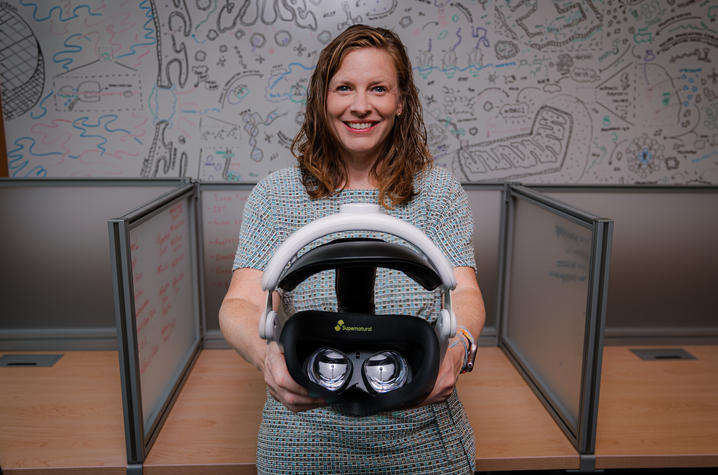
To help abate that fear, Brandi Frisby, Ph.D., associate provost for academic affairs and former acting dean of the University of Kentucky College of Communication and Information (CI) in the School of Information Science at the University of Kentucky, and her team examined how 360-degree video and virtual reality (VR) headsets can evolve public speaking pedagogy to better serve students and prepare them for the workforce. The goal was to provide a realistic practice environment that helps students manage fear before they step in front of a live audience.
“Public speaking is required at many high schools and almost every college,” Frisby said. “It's a really important skill for our students to have, not just for educational reasons, but also for preparing them for the workforce and the jobs and the careers that they hope to enter.”
360-degree video — which uses real footage of actual classrooms and peers — is a little different than from traditional animated VR. By standing in a digital version of their own classroom, students experience situational exposure that feels authentic, including audience members who check their phones or move in their seats.
“When the student put on that VR headset, it felt like they were standing in the middle of the classroom,” Frisby said. “Rather than seeing avatars or animated characters, they were seeing their actual classmates, actual chairs and tables and slides behind them.”
The study found that this realistic, low-stakes practice leads to tangible improvements in student performance and well-being.
“It gave them a safer environment for that practice experience,” Frisby said. “We were able to see increases in that confidence and decreases in their anxiety.”
Frisby’s research was enabled by a Celebrating University Research Across the Enterprise (CURATE) grant, a program funded by the Office of the Vice President for Research. The project was a collaborative effort involving Jessalyn Vallade, Ph.D., an associate professor in the School of Information Science within the College of Communication and Information, and Renee Kaufmann an associate professor in the School of Information Science within the College of Communication and Information, Joe Martin, Ph.D., a graduate student at the time of the study and now a senior lecturer in the Lewis Honors College and in the School of Information Science within the College of Communication and Information, and Kody Frey, Ph.D., who was also a graduate student at the time and now serves as an associate professor and director of public speaking at University of Tennessee, Knoxville.
“CURATE gave us this great opportunity to test an idea, to prove a hypothesis, and that gave us the foundation to potentially seek additional funding in the future,” Frisby said.
The insights gained from this research have implications for accessibility across the Commonwealth, particularly for students in rural communities where resources may be limited. Because the technology is cost-effective — with some headsets priced as low as $15 — it provides a way for Kentucky school systems to offer hands-on, skill-based practice that is more impactful than reading a textbook.
“As a university, we want our students to leave here as prepared as possible,” Frisby said. “Giving them those hands-on real-life experiences and being able to boost their confidence while we’re doing it, is a win-win for everyone.”

As the state’s flagship, land-grant institution, the University of Kentucky exists to advance the Commonwealth. We do that by preparing the next generation of leaders — placing students at the heart of everything we do — and transforming the lives of Kentuckians through education, research and creative work, service and healthcare. We pride ourselves on being a catalyst for breakthroughs and a force for healing, a place where ingenuity unfolds. It's all made possible by our people — visionaries, disruptors and pioneers — who make up 200 academic programs, a $1.02 billion research and development enterprise and a world-class medical center, all on one campus.